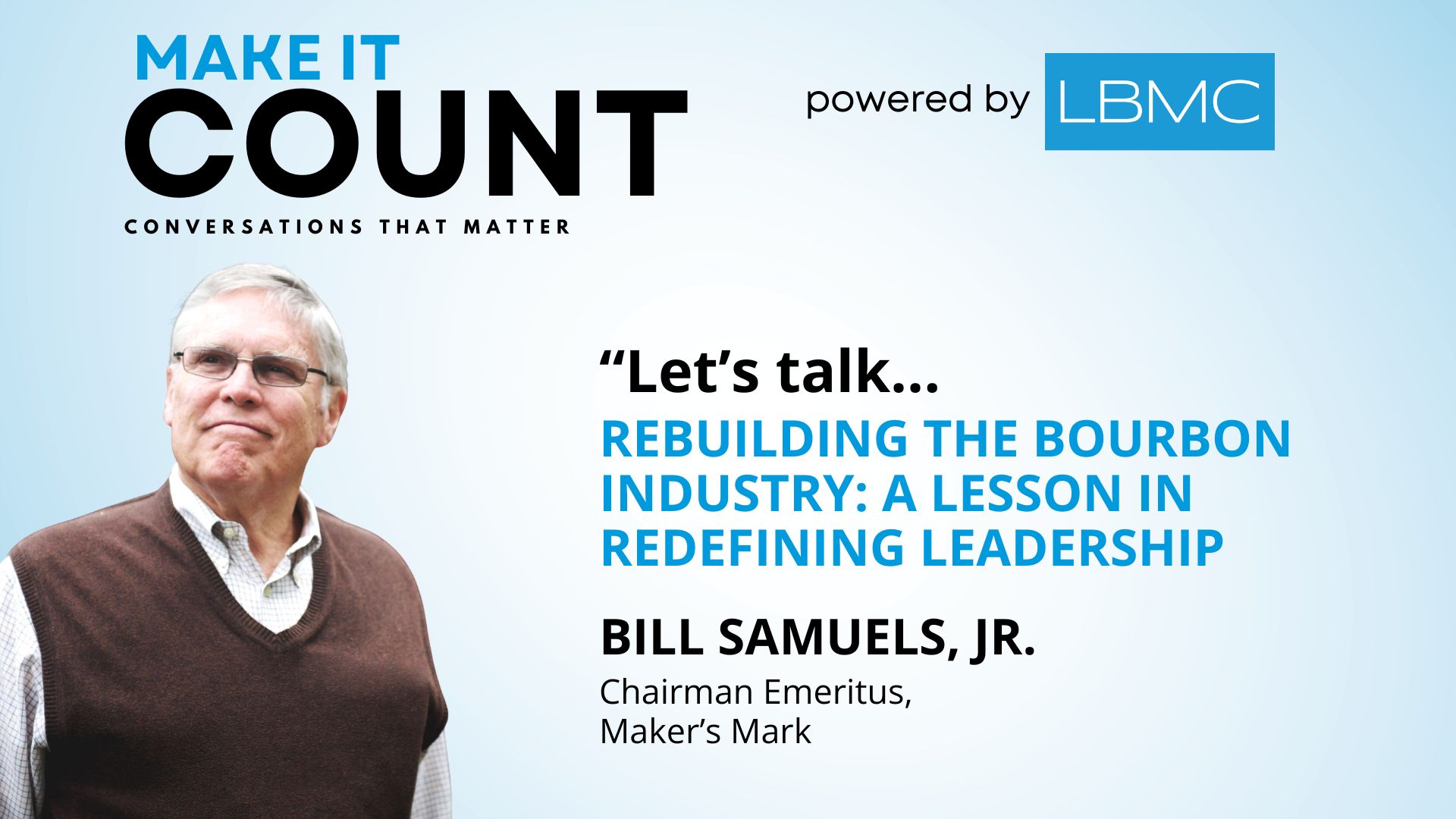
Rebuilding the Bourbon Industry: A Lesson in Redefining Leadership
Bill Samuels Jr., Chairman Emeritus of Maker’s Mark, shares how collaboration, disciplined leadership, and multigenerational vision helped revive the bourbon industry and transform Maker’s Mark into a nationally respected brand.
Key Takeaways:
- Build the Industry, Not Just the Brand: Long-term success sometimes requires collaborating with competitors — Bill helped reposition bourbon as a category first, allowing Maker’s Mark to thrive within a stronger industry.
- Discipline Protects Legacy: Conservative forecasting and intentional inventory management kept Maker’s Mark stable while others overextended — strategic restraint can be a competitive advantage.
- Leadership Is Stewardship: From mentoring his son to guiding his grandchildren, Bill demonstrates that true legacy leadership is about values, succession planning, and preparing the next generation to carry the vision forward.
Host Suzanne Reed joins Bill Samuels, Jr., Chairman Emeritus of Maker’s Mark, to explore the building of a brand and unpack how a collaborative vision transformed an entire industry, repositioning bourbon as a product of connoisseurship and creating a multigenerational legacy rooted in values, discipline, and long-term thinking.
Building an Industry Before Building a Brand
When Bill joined the family business in 1967, the bourbon industry was far from thriving. In fact, it was barely relevant.
“When Dad got into this, there wasn’t a relevant bourbon industry. It had died,” he shares. “Never really came out of prohibition very well.”
Rather than focusing solely on growing Maker’s Mark, Bill and his father made a bold, strategic decision: build the bourbon industry first.
“We made a conscious decision that we had to build an industry first, and that we would accept the fact that if we did that, we were going to have competitors.”
In a business world often driven by competitive secrecy, Bill chose collaboration. He actively worked with competing distillers to elevate bourbon as a category and compete against beer and wine instead.
“And it was really amazing working together, collaborating,” he says. “We’ve been able to take share from both beer and wine over the last 30 years, which meant we did a pretty good job of repositioning bourbon into a product with connoisseurship.”
The lesson for today’s leaders? Sometimes your real competition isn’t across the street — it’s outside your category entirely.
To understand the turnaround, you have to go back to Prohibition.
American whiskey struggled to regain its footing after Prohibition ended, especially compared to Scotch and Canadian imports.
“Canadian whiskeys did not have prohibition. Scotch whiskey and Irish whiskey did not have prohibition,” Bill recalls.
When Prohibition ended, American consumers had already experienced refined imports. Bourbon had to evolve — or fade away.
That’s where Bill’s parents stepped in, reinventing the product from the ground up.
“And that’s really what Mom and Dad did. They just stopped doing what they were doing and said, ‘Let’s start over so we can be relevant in today’s market.’”
It wasn’t just innovation for innovation’s sake. It was strategic reinvention tied directly to changing consumer expectations — a theme every modern business leader understands.
Leadership, Legacy, and Letting Go
At 86, Bill still shows up early.
“I’m still the first one in the office,” he admits, “I don’t do as much, but I’m here.”
But his leadership today looks different than when he took over the business in 1975. His focus now shifted from driving operations to preparing the next generation to do so.
“Well, the first thing, of course, was to get my son ready for the bows and arrows that were going to come at him,” he says. “Really, to make sure that he was known and received in the industry and in the company.”
The next thing Bill did was kind of get himself ready. “To be the volunteer helper, which meant don’t talk as much and only talk to him about business.”
Bill’s transition plan reflects a deeper leadership philosophy: stewardship over control.
He handed off the company with clarity and conviction:
“Rob, your job is to hang onto the values. Keep us in a position where we are non-union so that all of our people talk as equals, including us, and let’s become a highly respected international spirits brand.”
For family businesses and founder-led organizations, succession planning isn’t optional — it’s essential. Bill demonstrates how to transfer responsibility while preserving culture.
Discipline Behind the Romance
Bourbon may feel romantic, but Bill’s legacy includes disciplined operational decisions that protected the company long-term.
“Early on, I decided that one person needed to do that, not a committee, and we needed to be conservative because every distillery that had gone out of business in Kentucky had been over-exuberant on the forecasting end,” Bill reflects.
Strategic conservatism — especially in inventory management — helped Maker’s Mark avoid the boom-and-bust cycles that plagued others.
That kind of disciplined thinking is as relevant to accounting firms and consulting organizations as it is to distilleries.
“Everything needs to change every 30 years or so,” Bill offers. “Our customers are much, much younger than me, and that requires new blood.”
For him, the bourbon boom that began in the mid-1990s did more than drive sales — it revitalized the talent pipeline. An industry once short on fresh perspective suddenly attracted “an awful lot of talented young people,” giving bourbon not just momentum, but longevity.
That influx of energy and creativity, he believes, is what allows the industry — including his son’s leadership — to “keep the plates spinning with new offerings in new ways of talking about great whiskey.”
But innovation, in Bill’s view, doesn’t start in the marketing department.
“Flavor starts in the fields; it doesn’t start with the machinery.”
As consumer expectations evolved — especially among younger generations who are deeply concerned about sustainability — bourbon’s future depended on agriculture as much as branding.
By helping bring “flavor back to the grains, especially wheat,” the industry is investing upstream, reconnecting quality to soil health and environmental stewardship. After all, as Bill reminds us, “when your basic ingredients are nothing but water, yeast and grain, you better be concerned.”
In an era where ESG, sustainability, and supply chain resilience dominate executive conversations, Bill’s perspective feels ahead of its time — and grounded in fundamentals.
The Final Pour: Advice for the Next Generation
When asked what advice he gives his grandchildren, Bill’s answer is structured and direct:
“Plan, plan, plan.”
His recipe for success includes putting education first, becoming self-sufficient and intentional in following a career path. And then add in everything else.
It’s a philosophy consistent with the rest of his story: thoughtful, disciplined, long-term leadership.
Bill Samuels Jr.’s story isn’t just about bourbon. It’s about category creation, collaborative competition, operational discipline, family succession, and sustainable growth.
It’s about understanding that sometimes the most powerful move a leader can make is to build the ecosystem — not just the enterprise.
We can all raise a glass to that.
“My favorite drink at 86 is milk,” he chuckles. But if it’s going to be a bourbon and he trusts the bartender, he’ll take “a Maker’s Mark Old Fashioned.”
Listen to the full episode of Make It Count with Bill Samuels Jr. to hear more about rebuilding the bourbon industry, leadership legacy, and the power of collaboration.
Be sure to follow the Make It Count podcast on Apple, Spotify, YouTube, or wherever you get your audio content.